Etisalat spent four years on an ampersand. Then it went home.
Why e& took back the Etisalat name at 50, and the three tests every Gulf brand should run before it renames.
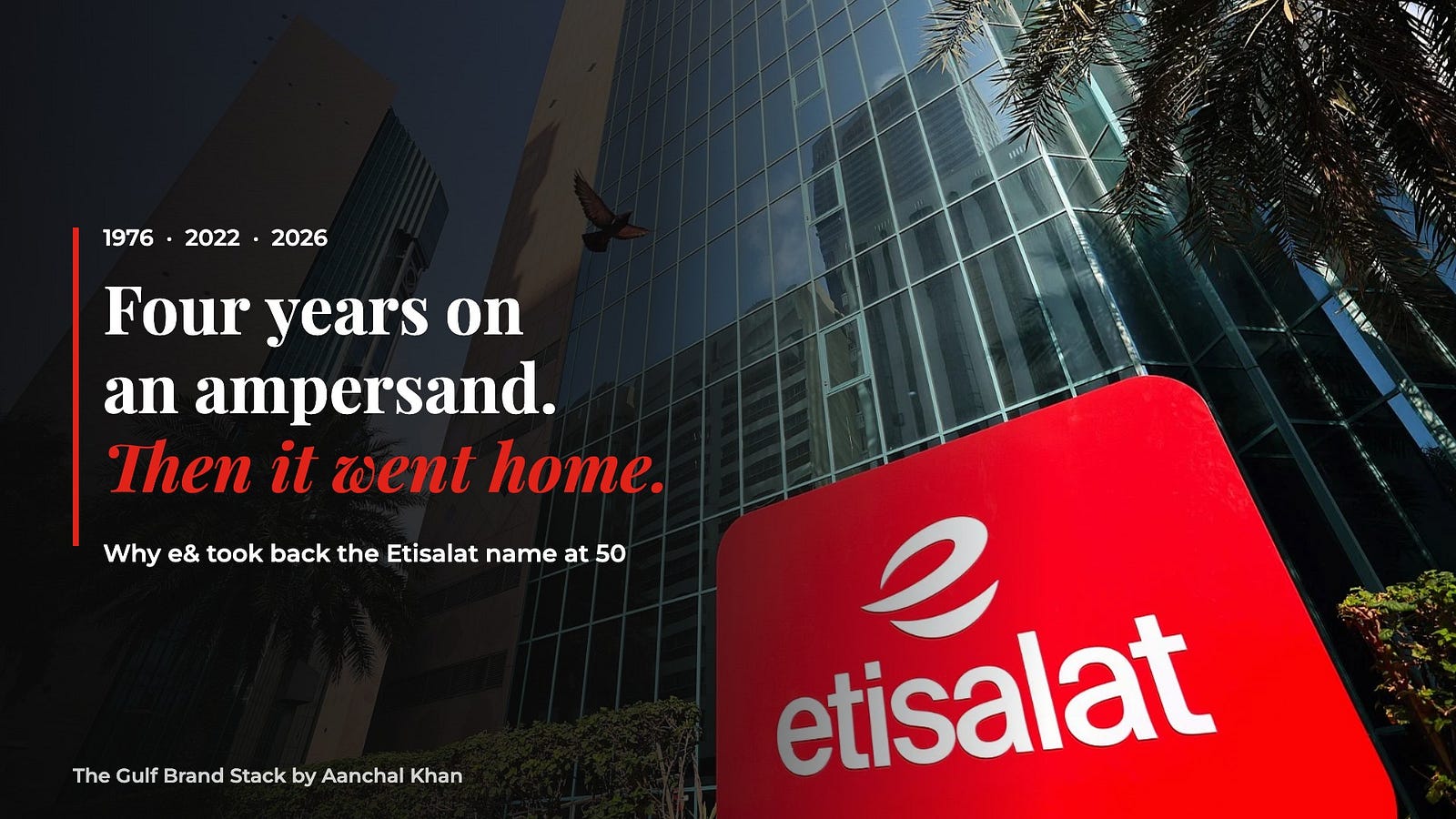
In October 2026, e& went back to the Etisalat name after a four-year rebrand, as the company turned 50 and its strategy moved back toward connectivity. The article sets out a rebrand checklist and three tests any Gulf brand should run before it renames, or reverts.
In February 2022, the UAE's biggest telecom group retired one of the best-known names in the region. Etisalat became e&.
In November 2024, it hired Jason Statham, Shah Rukh Khan, Lewis Hamilton and Megan Fox to tell the world what the "&" stood for.
On 6 October 2026, its 50th anniversary, it filed a short statement with the Abu Dhabi Securities Exchange: "Etisalat is the name we are taking forward."
Four years. One ampersand. Back to the start.
The easy read is that e& was a mistake. I don't think it was. I think the name was built for a strategy, and when the strategy changed, the name lost its job.
That is the most useful brand lesson in the Gulf this year, and it applies to every company that is tempted to rename itself to sound bigger.
In this article:
- What actually happened, year by year
- Why the "&" stopped making sense
- What a rebrand really takes, from the one I led at Multiplier
- A simple test: when to rebrand, and when to go back
- Brand Radar: five other stories Gulf marketers should know this week
Four years, year by year
The group changed its name twice in four years, and each change followed a change in strategy.
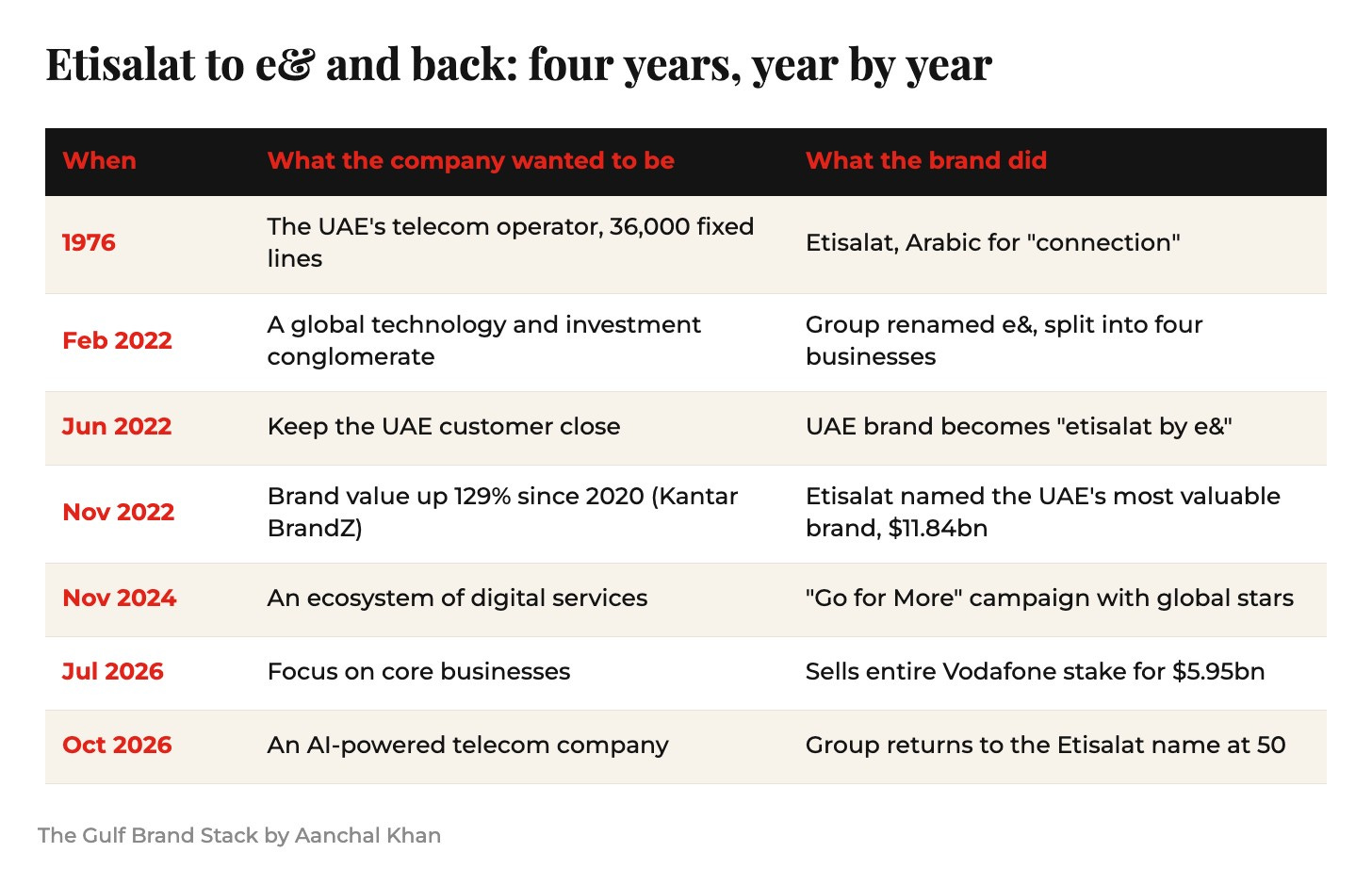
Two details in that timeline matter more than the rest.
First, the customer never really lost the name. Even at the height of the e& era, the UAE consumer brand still said "etisalat". The "&" lived mostly at group level: in investor decks, stock tickers and the global campaign.
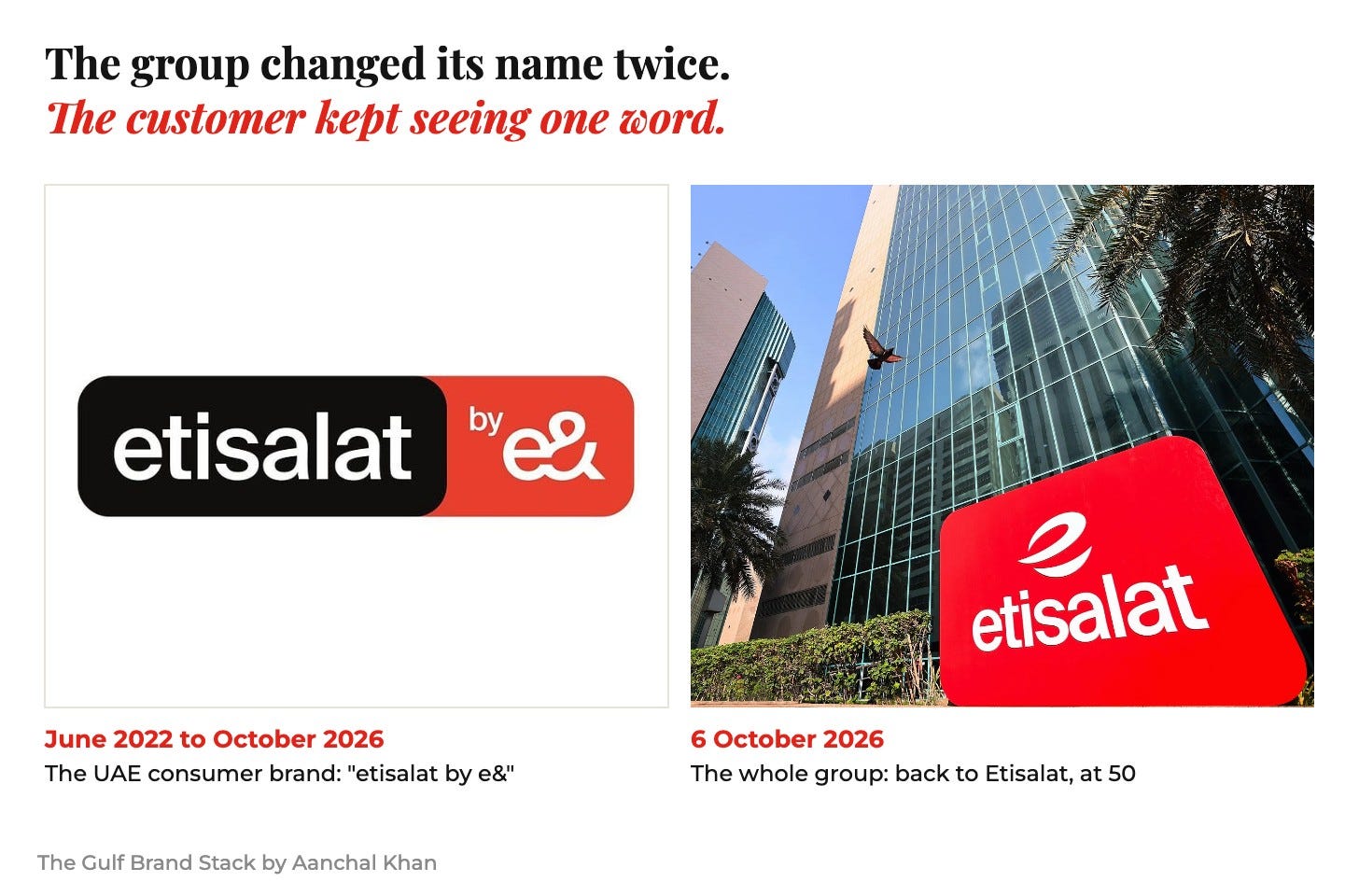
Second, Kantar valued the Etisalat brand at $11.84bn in the same year the group renamed itself. The group stepped back from the most valuable brand in the country in the very year it was ranked number one.
Why the "&" lost its job
The "e" stood for the telecom roots. The "&" stood for everything else: digital services, fintech, cloud, IoT and AI. It was a name for a holding company that wanted to be judged as a tech investor.
Then the strategy moved.
In July, e& agreed to sell its whole Vodafone stake to Xavier Niel's family group for $5.95bn, after a review of its international portfolio. It called the exit a way to "sharpen its strategic focus on core businesses".
In October, it set out a new strategy built on four engines: telco, AI and business solutions, infrastructure, and fintech. Its first big commitment is to raise international connectivity capacity from about 20 terabits per second to more than 500 by 2030, a 25-fold jump.
Read that list again. Every engine now runs on the network. The company is no longer selling "telecom and other things". It is selling connection, at a much bigger scale, to AI campuses, cloud providers and the 250 million subscribers it serves across 38 countries.
When the strategy is "and", you need an ampersand. When the strategy is connection, you need a name that means connection. Etisalat already did.
The company said it plainly: "Etisalat means connection. For 50 years, that purpose has guided what we build and the role we play."
The name is already working
In the five weeks since the switch, the Etisalat name has gone onto three launches that would have been hard to imagine under a telecom brand a few years ago.
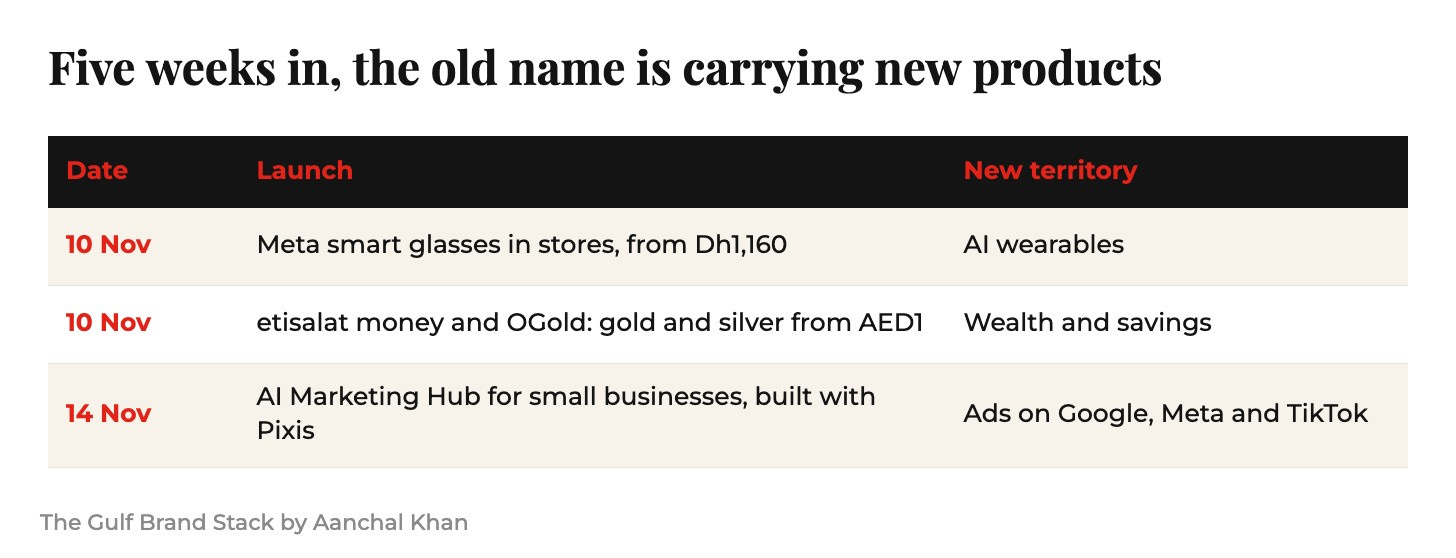
This is the part most commentary missed. Going back to Etisalat was not a retreat into being a telco. It took a name with 50 years of trust and started stretching it over new products. Gold from AED1 is easier to sell under a name your parents used than under a symbol.
What a rebrand actually takes
I have handled a rebrand from the inside. At Multiplier, a global B2B SaaS company, I led our website rebrand. It looked like a design project. It wasn't.
Here is the checklist I would hand any Gulf marketing team before it touches a logo:
- Positioning first. Write down what you stand for now that you did not stand for before. If that sentence is weak, stop. A new name will not fix it.
- Messaging. Every headline, tagline, product line and sales script gets rewritten. Budget the time for this, not just the agency fee.
- Visual identity. Logo, colours, type, imagery, templates. This is the part everyone sees, and the smallest part of the work.
- The touchpoint audit. Website, sales decks, email signatures, ads, social, app screens, invoices, signage, uniforms. The list is always longer than you think. Now picture it for a group present in 38 countries.
- SEO and redirects. Map every old URL to a new one, so years of search traffic and AI answers do not vanish overnight. In 2026, that includes checking what ChatGPT and Gemini say your company is called.
- Internal launch before external. If your sales team cannot explain the new brand in one sentence, customers will not get it either.
- Launch, then measure. Decide before launch what success looks like: search volume for the new name, direct traffic, brand recall. Then check it at 3, 6 and 12 months.
That was one website. Now imagine it at the scale of a group with more than 250 million customers.
The cost of e&'s four-year rebrand has never been disclosed. But you can see from the list why no rebrand is cheap, and why reversing one is never free.
When to rebrand, and when to go back
A name is the most expensive thing a company can change, and even harder to change back. So before you rename, run three tests.
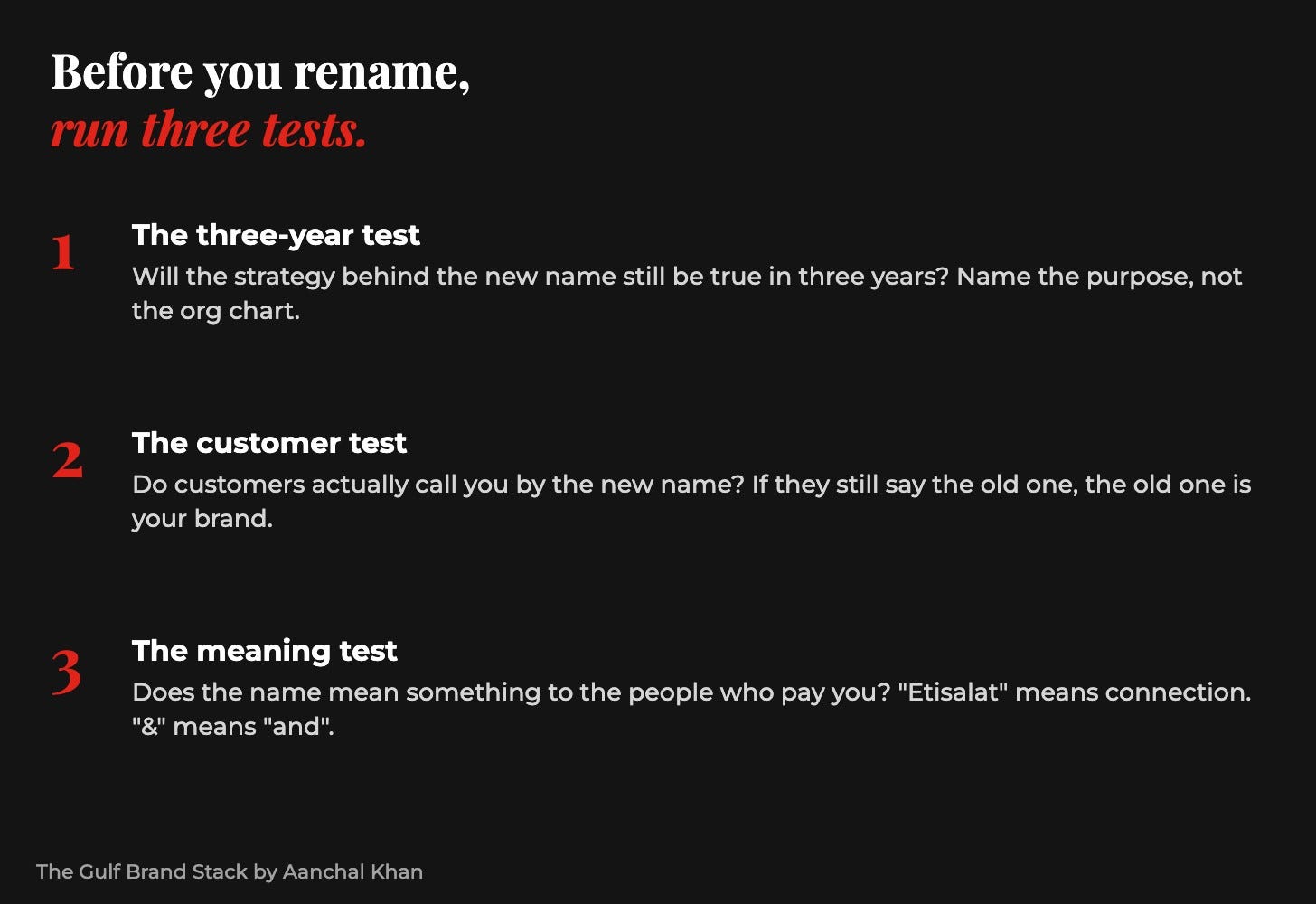
1. The three-year test. Will the strategy behind the new name still be true in three years? e& was named for a portfolio. When the portfolio changed, the name had nothing left to describe. Name the purpose, not the current org chart.
2. The customer test. Does your customer actually call you by the new name? If people still say the old one at the counter, on the phone and in Google, the old name is still your brand. The new one is a logo.
3. The meaning test. Does the name mean something to the people who pay you? "Etisalat" means connection in Arabic. An ampersand means "and". One carries a promise. The other needs a campaign to explain it.
And if you have already rebranded, three signs it may be time to go back:
- Your strategy has narrowed back towards what the old name described
- Customers and media still use the old name without being prompted
- You keep spending to explain what the new name means
Going back is not failure. Holding on to a name that no longer fits your strategy is the more expensive mistake.
The Gulf gap I see
Brands here often rebrand to sound global. Shorter names, English initials, symbols that travel.
Etisalat just showed that the most valuable thing it owned was a name that meant something at home. It did not need to sound global. It needed to mean something, and then it carried that meaning into 38 countries.
If you are a Gulf founder or CMO thinking about a new name this year, ask a simpler question first: what does our current name already mean to the people who pay us? You may find the brand you want is the one you already have.
Brand Radar: five more stories from this week
1. Saudi Arabia puts a price on fake reviews. The new Consumer Protection Law bans fake reviews and manipulated customer feedback, with penalties of up to SR8m ($2.13m) and up to two years in prison. It takes effect 180 days after publication in the Official Gazette. My read: if your social proof includes seeded reviews or paid comments, clean it up now, not in month five.
2. Shukran, one login for 20+ brands, had a data breach. Landmark Group is investigating a cyber incident in which names, contact details and dates of birth were exposed. Card details are not stored and points were not affected; customers are being told by SMS. My read: a shared loyalty programme shares the risk too. When it leaks, every logo on the card takes the hit.
3. UAE shoppers are ahead of UAE merchants on AI. An op-ed in Campaign Middle East, citing Visa's 2026 Global Digital Shopping Index, says 72% of UAE shoppers used AI in their most recent purchase, against 46% in the US. Only 19% of merchants have product data an AI agent can read. My read: shoppers have moved and most merchants have not. That gap is the biggest opportunity in Gulf retail marketing right now.
4. Athleta entered the Gulf without an American face. The US activewear brand launched with three regional women: Emirati racer Amna Al Qubaisi, Saudi trainer Lojain Alrefae and Egyptian cinematographer Salma Elkashef. My read: compare this with e&'s Hollywood line-up above. For a market entry, local faces now do the job celebrities used to.
5. The National Day brief is out. The 55th Eid Al Etihad on 2 December has the theme "Belonging in Unity", with branding built around family, in line with the Year of the Family. My read: the brands that stand out will show the family, not just the flag.
Brands are communication. Every touchpoint is a message.
Get the next article in your inbox every Tuesday.
Subscribe freeAanchal Khan is a Dubai-based marketing strategist and operator who runs marketing end to end and builds AI marketing automation. About Aanchal or work with her.
Also published on Substack.